In the Shadow of the Generals: Foreign Policy Making in Argentina, Brazil and Chile by Martin Mullins
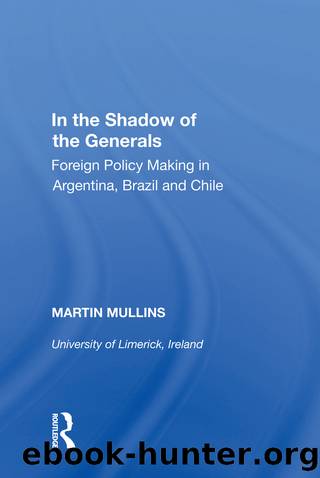
Author:Martin Mullins [Mullins, Martin]
Language: eng
Format: epub
Tags: Political Science, General
ISBN: 9781351155786
Google: 1fdADwAAQBAJ
Goodreads: 36984196
Publisher: Routledge
Published: 2006-08-31T00:00:00+00:00
All three conspire to make Brazil resist US domination in South America. However, unlike elsewhere on the continent, such ideas are unwritten by the notion of Brazil as a âbig countryâ with a corresponding national destiny.30 Brazilâs ambitions to counter US hegemony also finds expression in its insistence not to see Latin America as one security system but instead to stress the existence of South America as a separate security entity.
The nature of the environment in which the nation state finds itself in is also important. In the case of the Brazilian desire to pursue a more independent foreign policy and to be less beholden to the United States, the political and economic environment was critical. Over the past number of decades the environment has been unstable, some times being more favourable to Brazil and other times less so. The 1970s were a propitious time for Brazil to distance itself from the United States in that in economic terms Brazil was less dependent on the United States. The rise of Japan and Europe as world trading powers ensured that Brazil had alternative destinations for its products and other sources of investment capital. In security terms also, the advent of détente has lessened the tension between East and West and so the logic of the Cold War was less pressing in Brazilâs dealings with third parties. Thus, Brazil felt able to resist United Statesâ calls for a boycott of the Moscow Olympics and a grain embargo on the Soviet Union.
The 1980s saw the international environment for Brazil become much harsher and this in turn tended to restrict the nature of Brazilâs autonomy. Around Latin America the 1980s became known as the âlost decadeâ. The new circumstances afforded the United States the ability to exert more control within the Western Hemisphere. The imperative of economic growth continued, driven at least in part by the severity of the countryâs social problems, but the country was in severe debt. In 1980, the country was ill prepared by the sudden tightening of monetary policy in the US and Europe and a sharp rise in interest rates left Brazil floundering. Brazil became, âjust another supplicant at the IMFâ, hardly befitting a nation that aspired to great power status. The advantage of independent decision making in the economic field, which the military had enjoyed since 1967, disappeared.31 Its dependence on international financial institutions exposed the country to outside pressure, particularly from the United States.
For decades Brazil had based its development on the idea of import substitution industrialization (ISI). The logic behind this policy was that the Brazilian state would create an environment favourable to domestic industry, irrespective of foreign interests. The whole rationale of the foreign ministry, the Itamaraty, was based upon the politics of ISI and decisions on overseas trade were traditionally taken not by the Trade Ministry or the Finance Ministry but by the Itamaraty, an institution deeply committed to the idea of import substitution.32 The debt crisis of the 1980s undermined this policy set. The experience of Brazil in the Uruguay GATT round is instructive.
Download
This site does not store any files on its server. We only index and link to content provided by other sites. Please contact the content providers to delete copyright contents if any and email us, we'll remove relevant links or contents immediately.
| Arms Control | Diplomacy |
| Security | Trades & Tariffs |
| Treaties | African |
| Asian | Australian & Oceanian |
| Canadian | Caribbean & Latin American |
| European | Middle Eastern |
| Russian & Former Soviet Union |
The Secret History by Donna Tartt(19088)
The Social Justice Warrior Handbook by Lisa De Pasquale(12190)
Thirteen Reasons Why by Jay Asher(8909)
This Is How You Lose Her by Junot Diaz(6887)
Weapons of Math Destruction by Cathy O'Neil(6279)
Zero to One by Peter Thiel(5802)
Beartown by Fredrik Backman(5754)
The Myth of the Strong Leader by Archie Brown(5507)
The Fire Next Time by James Baldwin(5444)
How Democracies Die by Steven Levitsky & Daniel Ziblatt(5218)
Promise Me, Dad by Joe Biden(5153)
Stone's Rules by Roger Stone(5088)
A Higher Loyalty: Truth, Lies, and Leadership by James Comey(4964)
100 Deadly Skills by Clint Emerson(4925)
Rise and Kill First by Ronen Bergman(4789)
Secrecy World by Jake Bernstein(4753)
The David Icke Guide to the Global Conspiracy (and how to end it) by David Icke(4718)
The Farm by Tom Rob Smith(4509)
The Doomsday Machine by Daniel Ellsberg(4490)
